
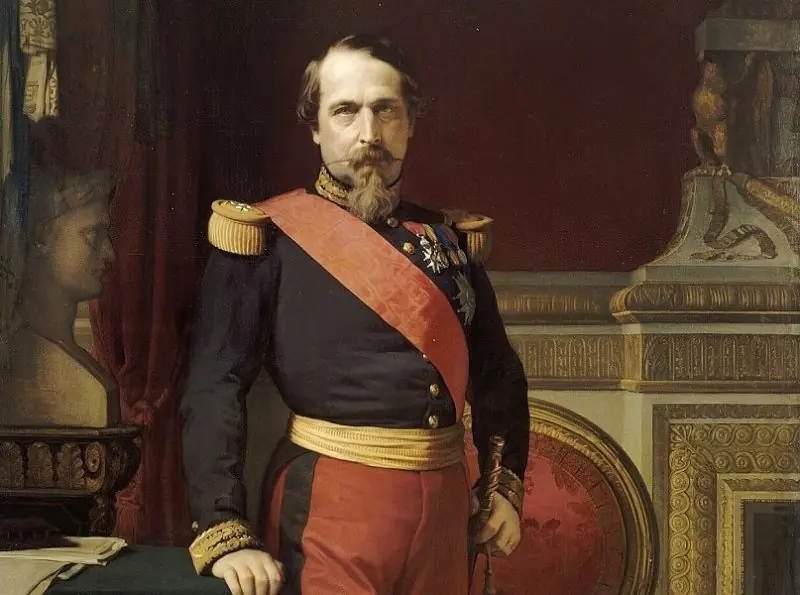
How Charles Louis Napoleon Bonaparte escaped prison, seized power through coup d’état, built the Second Empire, and lost everything in the Franco-Prussian War
Imagine a prisoner pacing the stone corridors of Ham fortress in 1846. For six years, this inmate had enjoyed unusual privileges—books, writing materials, even romantic affairs with servants. Yet he remained incarcerated for attempting to overthrow the French government. One day, he borrowed a construction worker’s uniform, walked past unsuspecting guards, and escaped to England. Within two years, this same fugitive would become President of France. Within four, he would declare himself Emperor. The strange career of Napoleon III demonstrates how ambition, luck, and historical memory can elevate even unlikely candidates to absolute power—and how quickly such power can collapse.
Charles Louis Napoleon Bonaparte (1808-1873) remains one of history’s most improbable rulers. Nephew of the legendary Napoleon I, he inherited not territory or treasury but a name that opened doors and closed minds. Through two failed coups, political reinvention, and calculated patience, he constructed the Second French Empire (1852-1870), presiding over industrial modernization and urban transformation. Yet his reign ended in military catastrophe, imprisonment, and exile—a trajectory that mirrored his famous uncle’s, though with less glory and greater irony.

Origins: The Bonaparte Inheritance
Born in 1808 at Saint-Cloud, Charles Louis entered a family already marked by imperial destiny. His father Louis was Napoleon I’s brother; his mother Hortense de Beauharnais was Josephine’s daughter. The marriage was political, dissolved before his birth, leaving Charles Louis to wander Europe with his mother and brother after 1815. They eventually settled in Switzerland, where young Charles developed passionate admiration for his exiled uncle.
This identification was encouraged by tutors—Abbé Bertrand and Philippe Lebas, son of a Jacobin director—who shaped his political imagination. Queen Hortense reinforced the message: her son possessed great destiny requiring persistent pursuit. Despite gentle personal nature, Charles Louis absorbed this ambition utterly.
His military career began conventionally. Enlisting in Swiss artillery, he rose to captain by 1835. Then fate intervened: in 1832, Napoleon I’s only legitimate son, Napoleon II, died. The Bonapartist succession passed to 22-year-old Charles Louis—an inheritance of claim without substance, title without territory.

Failed Coups and Prison Education
King Louis Philippe’s government underestimated this pretender, who openly expressed republican sympathies while maintaining monarchist ambitions. In 1836, Charles Louis attempted his first coup—almost farcical in execution. Wearing Napoleon I’s uniform, he appeared at a Strasbourg barracks with a dozen officers. His companion announced revolution had succeeded, the king deposed, and Charles Louis would rule as Napoleon II. Soldiers of the second regiment arrested the conspirators immediately.
Louis Philippe exiled Charles Louis to America. He returned within a year for his dying mother, then moved to England as a former conspirator. The 1840 transfer of Napoleon I’s body to Paris revived Bonapartist sentiment, prompting a second attempt. Chartering a steamship, Charles Louis landed at Boulogne with supporters on August 6, 1840. Soldiers of the first regiment he approached arrested him directly.
This failure proved educational. Imprisoned at Ham fortress for six years, Charles Louis enjoyed relative freedom. He studied continuously, writing works on state improvement. He fathered two sons with Eleanor Vergo, his maid and seamstress. Most importantly, he planned. In 1846, disguised as a construction worker, he walked free and returned to England—awaiting opportunity.
Read More:

The 1848 Revolution: From Exile to Presidency
When revolution erupted in February 1848, Charles Louis Napoleon hurried to Paris. In May, four departments elected him to the provisional government; he declined, calculating larger prizes. His support came from peasants and workers who saw Bonaparte as genuine republican reformer—not the conservative he had become.
September brought Constituent Assembly elections; Charles Louis won five departments and joined the government. In November 1848, he announced his presidential candidacy promising civil liberty inviolability, social progress, and firm governance. The December vote gave him victory by two-to-one margin. On December 20, 1848, Charles Louis Napoleon Bonaparte became France’s first elected president.
His republican commitments proved theatrical. As president, he wore Republican Guard general’s uniform rather than civilian clothes, signaling military ambitions. Without consulting ministers, he sent French troops to Italy in 1849, defending Pope Pius IX against Garibaldi’s unification movement. Republican deputies, Garibaldi sympathizers, demanded impeachment; liberals attempted power seizure. Presidential troops crushed Paris barricades, banned republican clubs, and drove opponents abroad.
Having pledged republican loyalty, Charles Louis now moved toward abolition. On December 2, 1851—anniversary of Napoleon I’s coronation—he staged coup d’état with army support and English financial backing. The January 1852 constitution granted absolute power. One year later, he declared himself Emperor Napoleon III.

The Second Empire: Achievement and Contradiction
Napoleon III’s reign combined genuine modernization with personal insecurity. He married Eugénie de Montijo, Spanish countess, in January 1853. Two sons followed; the first died in infancy, the second—Napoleon IV—would die fighting Zulus in South Africa in 1879, aged 23.
Crimean War success (1853-1856) brought international recognition. In 1855, Queen Victoria, Sardinian and Portuguese kings visited Paris—validation Napoleon III craved. Yet Italians hated him for obstructing republican unification, attempting his life three times. He defeated Austria in 1859, occupied Mexico (1862-1867), and conducted expeditions in China, Japan, and Syria. Each venture sought glory; none secured lasting advantage.
Domestic achievements proved more durable. Napoleon III initiated France’s Industrial Revolution, building railways that transformed economic geography. He commissioned Baron Haussmann’s Paris reconstruction—creating broad boulevards, sewers, and modern infrastructure that defines the city today. State insurance protected disabled workers; child labor was limited; Sunday became public holiday. The 1869 margarine invention—rewarded by imperial prize—typified his encouragement of practical innovation.
Most significantly, Napoleon III supported the Suez Canal’s construction, securing French influence in the Mediterranean-Red Sea passage. Economic and cultural life flourished; France seemed to recover Napoleonic greatness without Napoleonic warfare.

The Franco-Prussian Catastrophe
Prussia’s 1866 victory over Austria transformed European power balance. Chancellor Bismarck skillfully manipulated Napoleon III into isolation, then confrontation. The 1870-1871 Franco-Prussian War revealed catastrophic French unpreparedness. At Sedan, Napoleon III surrendered personally to German forces. Kaiser Wilhelm I ordered his residence in Kassel palace until war’s end.
Defeat dissolved the Second Empire. France lost Alsace and Lorraine; Paris Commune uprising followed, which Karl Marx considered first proletarian dictatorship. Louis Adolphe Thiers became Third Republic president. Napoleon III lost crown, kingdom, and historical reputation simultaneously.
Read More:

Exile, Death, and Legacy
Released after peace, Napoleon III moved to England. Chronic kidney disease killed him in January 1873, aged 64. His widow Eugénie purchased Farnborough property in 1880, converting St. Michael’s Abbey into monastery and mausoleum. There the last Emperor rests—far from Parisian glory, closer to English exile than French immortality.
Assessment remains contested. French credit includes industrialization, railway construction, urban transformation, Suez Canal, worker protections, and cultural flourishing. Critics emphasize constitutional manipulation, foreign policy failures, and catastrophic war initiation. Historical judgment generally places him below his uncle—an imitator without equivalent genius, a reformer whose achievements were overshadowed by military collapse.
Yet Napoleon III’s career fascinates precisely because it shouldn’t have succeeded. Twice imprisoned, twice exiled, perpetually underestimated—he constructed an empire through patience and calculation that his impulsive uncle would have despised. His fall demonstrated that Bonaparte magic required Bonaparte talent; the name alone could not preserve what military incompetence destroyed. The nephew’s tragedy was understanding Napoleonic glory sufficiently to pursue it, insufficiently to achieve it.

Physical memorials remain. Milan’s Parco Sempione honors his 1859 liberation from Austria. Five films (1940-2012) examined his career. Numismatists worldwide collect his gold and silver coinage. These artifacts commemorate not greatness but ambition—reminding us that historical significance requires neither virtue nor success, merely sufficient scale to alter events and attract memory.
Primary Topics: Napoleon III, Second French Empire, Charles Louis Napoleon Bonaparte, 1848 French Revolution, coup d’état 1851, Crimean War, Franco-Prussian War, Paris Commune, Haussmann Paris, Suez Canal, Bonapartism, French history 19th century, Louis Napoleon Bonaparte biography