
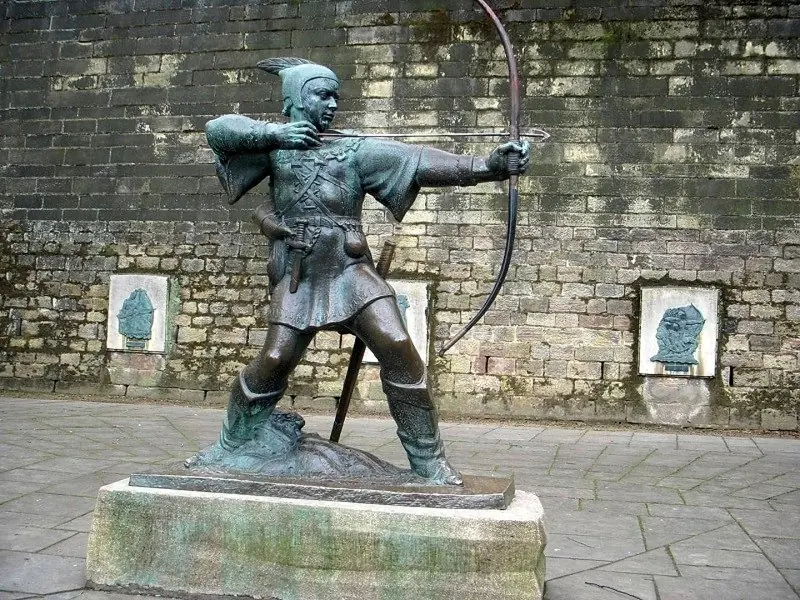
Was Robin Hood a real medieval outlaw or merely England’s most enduring folk tale? For centuries, historians have chased shadows through Sherwood Forest, trying to catch a man who may never have existed—or who might have been several men combined into one legendary figure. The noble robber who stole from the rich and gave to the poor remains as captivating today as he was to medieval audiences, yet the truth behind the myth proves far more elusive than the arrow Robin supposedly fired from his deathbed.
Who Was Robin Hood? Unpacking the Legend
Picture this: it’s the late 12th century, and deep within Sherwood Forest near Nottingham, a band of outlaws led by a master archer ambushes royal tax collectors. Their leader, cloaked in Lincoln green, redistributes the spoils to starving peasants while evading the Sheriff of Nottingham’s relentless pursuit. This romantic image—immortalized in countless films from The Adventures of Robin Hood (1938) to Russell Crowe’s 2010 portrayal—has shaped our understanding of England’s favorite folk hero.

But here’s where it gets complicated. The Robin Hood of early ballads bears little resemblance to the Hollywood version. No Maid Marian. No Friar Tuck. No noble birthright. Instead, medieval sources depict a violent yeoman—a commoner—who operated during wildly different time periods depending on which account you read. Some chroniclers place him during Richard the Lionheart’s reign (1189-1199); others swear he fought alongside Simon de Montfort against Henry III in the 1260s.
“I kan noght parfitly my Paternoster as the preest it syngeth, But I kan rymes of Robyn Hood,” wrote William Langland in 1377. This passing reference in Piers Plowman reveals something crucial: by the late 14th century, even illiterate peasants knew Robin’s stories by heart. The legend had already sunk deep into English cultural soil—but how did it take root?

Robin Hood Historical Evidence: What the Records Actually Show
The hunt for a historical Robin Hood leads us down some fascinating rabbit holes. Unlike King Arthur—whose earliest mentions appear centuries after his supposed existence—references to “Robin Hood” emerge remarkably early in English history. Between 1261 and 1300, court rolls across England from Berkshire to York mention criminals nicknamed “Robehod,” “Rabunhod,” or “Robynhood.” These weren’t compliments; by the 13th century, the name had become generic slang for outlaws.
But did any of these Robins inspire the legend? Let’s examine the leading candidates:
Robert Hod of York: The Earliest Documented Outlaw
In 1226, the York Assizes recorded a “Robert Hod” whose goods—worth 32 shillings and sixpence—were confiscated after he became an outlaw. The following year, records call him “Hobbehod.” Historian L.V.D. Owen discovered these references in 1936, sparking excitement that we’d found our man. Yet there’s a catch: this Robert Hod owed money to St. Peter’s Church, and while he was definitely an outlaw, nothing connects him to banditry, Sherwood Forest, or charitable redistribution.
Still, the timing intrigues. The 1220s sit squarely within the reigns of both King John and Henry III—the very period later chroniclers associate with Robin Hood. Could this fugitive from York justice have sparked rumors that grew into legend?

Roger Godberd: The Rebel With a Cause
Medieval historian David Baldwin made a compelling case for Roger Godberd, a die-hard supporter of Simon de Montfort who fought against Henry III during the Second Barons’ War (1264-1267). After the royalist victory at Evesham, Godberd became a fugitive, hiding in Sherwood Forest and defying authorities for years. Sound familiar?
Godberd’s biography mirrors Robin Hood’s ballads with eerie precision: forest refuge, conflict with royal authority, even eventual capture at a religious house. John Maddicott, another respected medievalist, called Godberd “that prototype Robin Hood.” Yet no contemporary source explicitly names Godberd as “Robin Hood,” and the ballads lack the specific political context of de Montfort’s rebellion.
The Composite Theory: Multiple Men, One Legend
Perhaps the most convincing explanation? Robin Hood represents a “folk memory” of multiple outlaws spanning roughly a century (1190-1290). This theory accounts for the conflicting dates, locations, and details in various sources. As historian J.C. Holt argued, the name likely attracted exploits from various bandits until it crystallized into the figure we recognize today.
“Historians delving deeper into the Middle Ages have uncovered more than one man called Robin Hood,” notes the BBC. “So while we can find record of a man (or several men) known as Robin Hood existing, we sadly can’t confirm if they wore green by choice or regularly handed out stolen goods.”

Robin Hood’s Death and Burial: The Kirklees Mystery
Every legend needs an ending, and Robin Hood’s is appropriately tragic. According to the 15th-century ballad Robin Hood’s Death, the aging outlaw traveled to Kirklees Priory in Yorkshire, seeking medical treatment from his cousin, the Prioress. Instead of healing him, she—possibly influenced by Robin’s enemy Sir Roger of Doncaster—bled him to death through deliberate medical malpractice.
With his last strength, Robin blew his hunting horn three times, summoning Little John. The faithful companion carried his dying master to a window, where Robin fired a final arrow, commanding burial wherever it landed. Little John supposedly laid his leader to rest with sword at head, arrows at feet, and trusty bow at his side.
But did this actually happen? The Wikipedia entry on Robin Hood explains that while Kirklees Priory certainly existed (until Henry VIII dissolved it in 1539), the grave’s authenticity remains hotly disputed. Richard Grafton’s 1569 Chronicle at Large first described a stone marking Robin’s grave “by the high way side,” yet the current monument dates from the 18th century at earliest.
In 2015, the Discovery Channel’s Expedition Unknown conducted ground-penetrating radar tests at the site. Their findings? No evidence of ground disturbance suggesting a burial. The epitaph visible today—dated “24 kalends of December 1247″—uses pseudo-archaic English that didn’t exist in the 13th century. As one historian noted, it’s likely a romantic embellishment added centuries after the fact.

From Yeoman to Earl: How the Legend Evolved
The Robin Hood we meet in early ballads is emphatically not nobility. He’s a yeoman—a free commoner—whose attitudes reflect middle-class frustrations with corrupt officials and oppressive forest laws. So how did he become the Earl of Huntingdon?
Blame the 16th-century antiquarian Richard Grafton, who claimed to find an “old and ancient pamphlet” elevating Robin to earldom. Playwright Anthony Munday ran with this idea in his 1598 dramas, creating the dispossished aristocrat narrative that Walter Scott later popularized in Ivanhoe (1819). The real Earl of Huntingdon in the 1190s was actually David of Scotland—who died in 1219, making Robin’s claimed title historically impossible.
Other “accretions” to the legend followed similar patterns. Maid Marian originally belonged to separate May Day festivities, possibly merged with Robin’s story during the Protestant Reformation to replace his devotion to the Virgin Mary. Friar Tuck appears in 15th-century dramatic fragments, while the “Merry Men” grew from generic outlaw terminology.

Robin Hood in Popular Culture: Why the Legend Endures
Despite—or perhaps because of—his uncertain origins, Robin Hood has conquered global popular culture. The first film adaptation appeared in 1908; since then, over 100 cinematic versions have followed, including Disney’s 1973 animated classic and Kevin Costner’s Robin Hood: Prince of Thieves (1991). The 1938 Errol Flynn version remains a masterpiece of swashbuckling cinema, winning three Academy Awards.
But the legend’s power transcends entertainment. During the medieval period, Robin Hood plays served as social criticism, allowing commoners to mock authority safely through performance. In the 18th century, revolutionaries on both sides of the Atlantic invoked Robin Hood to justify redistribution of wealth. Even today, “Robin Hood” remains shorthand for taking from the rich to benefit the poor—whether discussing tax policy, cryptocurrency, or hedge fund strategies.
The Soviet Union produced its own fascinating adaptations, including Vladimir Vysotsky’s excluded ballads for the 1975 film The Arrows of Robin Hood. North Korea even issued a commemorative coin in 1996, proving the outlaw’s truly global appeal.

Conclusion: Legend, History, and the Power of Story
So, was Robin Hood real? The honest answer: probably not as a single individual, but quite possibly as a composite of real outlaws whose exploits coalesced into one unforgettable figure. The historical evidence suggests multiple candidates—Robert Hod of York, Roger Godberd, perhaps others lost to time—whose stories merged with older folk traditions about righteous bandits.
Yet in another sense, Robin Hood is absolutely real. He’s real in the impact he’s had on English culture, on concepts of justice, and on how we imagine resistance to tyranny. Every generation reinvents him to suit their needs: yeoman hero for medieval commoners, noble patriot for Elizabethan audiences, romantic rebel for Victorian readers, and action hero for modern moviegoers.
Perhaps that’s the real magic of Robin Hood. Whether he existed as one man, several men, or merely as the collective wish-fulfillment of oppressed peasants, his story continues to resonate because it speaks to something fundamental in human nature—the desire to believe that sometimes, the underdog wins, justice prevails, and the arrow flies true.
What’s your take? Does it matter whether Robin Hood actually existed, or is the legend’s cultural impact more important than historical accuracy? Share your thoughts below.