
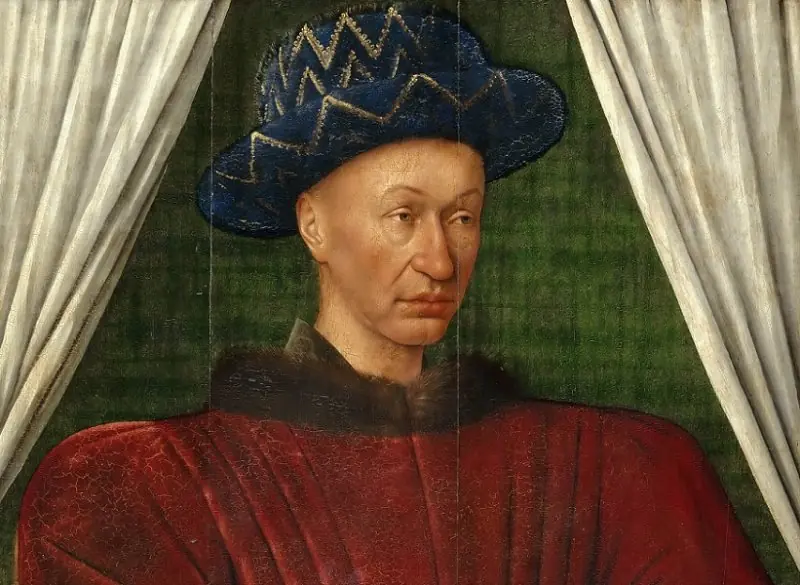
What does it take to save a kingdom when everyone believes you’ve already lost it? Charles VII of France faced this impossible question for the first seventeen years of his reign. Disinherited by his own parents, mocked as “the King of Bourges” for the modest city that served as his capital, and hunted by the greatest military power of the age—his story should have ended in obscurity. Instead, thanks to a teenage peasant girl who heard voices, he became one of France’s most consequential monarchs. This is the remarkable tale of how Charles VII transformed from disputed dauphin to victorious king, though history would never forgive him for abandoning the woman who made it all possible.
Who Was Charles VII? The Disinherited Prince
Imagine being told by your own mother that you’re not your father’s son. In 1421, that’s precisely what happened to Charles, the fifth-born child of Charles VI “the Mad” and Isabella of Bavaria. The political reasons were brutally clear: France had been shattered by the Hundred Years’ War, Paris was occupied by English troops, and the Treaty of Troyes had declared the English King Henry V heir to the French throne. By publicly questioning Charles’s legitimacy, his parents hoped to keep him alive—while simultaneously destroying his claim to rule.
But let’s step back. Born in Paris in 1403, young Charles seemed destined for a minor role in history. Three older brothers stood between him and the crown. Yet fate, that capricious architect, intervened repeatedly. Disease claimed his brothers one by one. By age fifteen, Charles found himself Dauphin of France—heir apparent to a throne that increasingly looked like a poisoned chalice.

The France Charles inherited was not the unified kingdom we picture today. It was a fractured patchwork of warring factions. The Armagnacs, representing southern nobility, supported the dauphin. The Burgundians, powerful dukes controlling the prosperous north, had their own ambitions. And hovering over everything like a storm cloud: England, led by the warrior-king Henry V, who seemed unstoppable after his crushing victory at Agincourt in 1415.
The Flight from Paris: Survival Against All Odds
May 1418 changed everything. Burgundian forces captured Paris, and the streets ran red with Armagnac blood. Seventeen-year-old Charles barely escaped with his life, fleeing south while his supporters were massacred in the capital. The Burgundians had won—or so it seemed.
Here’s where the tragedy deepens. In September 1419, Armagnac extremists assassinated John the Fearless, Duke of Burgundy, during peace negotiations. The murder was spectacularly ill-timed. John’s son, Philip the Good, swore vengeance and did the unthinkable: he allied with the English. The Treaty of Troyes (1420) made Henry V regent of France and heir to Charles VI, effectively erasing the dauphin from succession.

“It was as if the earth had opened beneath our feet,” one contemporary chronicler wrote. Charles found himself ruling a rump kingdom south of the Loire River, his “capital” the city of Bourges. English propaganda mocked him as “the King of Bourges”—a petty lordling pretending to majesty. His own parents had publicly branded him illegitimate. The future looked bleak indeed.
Yet Charles possessed qualities that wouldn’t become apparent until later: patience, political cunning, and an eye for talent. Most crucially, he found an unlikely protector in Yolande of Aragon, the formidable Duchess of Anjou. This remarkable woman—queen in her own right, politician, and strategist—saw potential in the exiled dauphin. In 1422, she married him to her daughter Marie. The alliance would prove transformative.

Read More:
Joan of Arc: The Maid Who Changed Everything
By 1429, the situation had become desperate. The English were besieging Orléans, the last major Armagnac stronghold in northern France. If it fell, Charles’s cause was finished. Then, in a village called Domrémy, a sixteen-year-old peasant girl began hearing voices.
Joan of Arc—Jeanne d’Arc to the French—claimed that Saint Michael, Saint Catherine, and Saint Margaret had commanded her to save France. Historians have debated for centuries: was she mentally ill? A political tool? A genuine mystic? What matters is that she believed, and she made others believe too.
When Joan arrived at Charles’s court in Chinon on March 10, 1429, she was an unwashed, illiterate teenager in male clothing. Yet she carried something Charles desperately needed: certainty. “I am not sent by any man,” she reportedly told him. “I am sent by the King of Heaven.” In a private conversation that remains mysterious—some sources suggest she revealed a secret prayer only Charles knew—she convinced him of her divine mission.

What happened next defies military logic. Joan led French forces to Orléans, arriving in early April 1429. Nine days later, the English lifted the siege—a turnaround so rapid it seemed miraculous. On June 18, at Patay, French cavalry crushed English longbowmen for the first time in decades. The road to Reims, the traditional coronation city, lay open.
On July 17, 1429, Charles VII was anointed king in Reims Cathedral, with Joan standing nearby holding her banner. The ceremony transformed him from disputed dauphin to consecrated monarch in the eyes of God and—crucially—his subjects. “Gentle King,” Joan had called him during their first meeting. Now he was King indeed.
The Betrayal: How Charles VII Abandoned Joan of Arc
Here is where Charles VII’s legacy becomes complicated—some would say stained. After the coronation, Joan’s military luck faltered. Failed sieges of Paris and La Charité damaged her reputation. In May 1430, during an attempt to relieve Compiègne, Burgundian forces captured her.
The Burgundians, eager to prove loyalty to their English allies, sold Joan to the enemy. The English, viewing her as a witch and political threat, put her on trial for heresy in Rouen. The proceedings were a sham, the verdict predetermined. On May 30, 1431, nineteen-year-old Joan of Arc was burned alive in the market square.
Charles VII did nothing.
This silence haunts his reputation. He owed his crown to this peasant girl. She had risked everything for him. Yet when she needed rescue—when a prisoner exchange or military threat might have saved her—he remained passive. Why?
Historians offer explanations, though none fully excuse: Charles was politically weak, unable to challenge the English; Joan had become embarrassing after her military failures; her voices contradicted the Church that had just validated his kingship. Yet the fact remains. “The most heinous betrayal in French history,” many French historians call it. Charles VII saved France, but he sacrificed its savior.

Read More:
Victory and Consolidation: The King’s Reforms
Despite this moral failure, Charles VII proved an effective ruler. In 1435, he achieved what years of warfare couldn’t: the Treaty of Arras reconciled Burgundy with France. Philip the Good abandoned the English alliance, and the tide turned decisively.
Between 1436 and 1453, French forces systematically expelled the English from Normandy, Guyenne, and finally Gascony. By the war’s end, only Calais remained in English hands—and that would fall in 1558. The Hundred Years’ War, begun in 1337, was finally over. Charles VII had fulfilled his coronation promise.
His domestic achievements matched his military success. The “Compagnies d’ordonnance” created France’s first standing army—a professional force that replaced unreliable feudal levies. The “francs-archers” established a militia system. These reforms made France the dominant military power in Europe for generations.
Charles also founded the University of Poitiers (1432), expanded the Parlement of Paris, and reformed the tax system. The gold coins minted during his reign—the royal d’or, the new écu, and the gold franc—testified to restored royal authority and economic recovery. From the brink of extinction, France had become Europe’s strongest kingdom.

Family Tragedy: The Conflict with Louis XI
Personal happiness, however, eluded Charles. His marriage to Marie of Anjou produced fourteen children—nine daughters and five sons—but the relationship with his heir, Louis, curdled into hatred. The Dauphin Louis was brilliant, cunning, and utterly untrustworthy. He repeatedly plotted against his father, intrigued with enemies, and interfered in governance.
In 1446, after Louis’s conspiracy involving a second son’s birth, Charles exiled him from court. In 1456, Louis fled to Burgundy, where Philip the Good protected him. Father and son would not meet again for years.
When Charles fell gravely ill in 1458—likely suffering from diabetes—he summoned Louis to his bedside. The heir’s response was chilling: he consulted astrologers to predict when his father would die rather than rushing to his side. Charles VII passed away in July 1461, aged fifty-eight, largely unmourned by the son who succeeded him.
He was buried at Saint-Denis, the necropolis of French kings, beside the parents who had once disowned him. The tomb speaks volumes: Charles VII, the survivor, the king who saved France, rests with those who tried to destroy him.

Read More:
Legacy: The Victorious King History Forgot
Charles VII presents a historical paradox. He achieved everything a medieval king could desire: military victory, territorial recovery, institutional reform, and dynastic continuation. Yet his reputation suffers from comparison with his predecessor (the tragic Charles VI) and his successor (the cunning Louis XI, “the Universal Spider”).
Worse, he remains forever linked to Joan of Arc—and to his betrayal of her. Every retelling of her story casts him in an unflattering light. Films, novels, and television series have explored his reign, yet always through the lens of the Maid’s tragedy.
Perhaps this is fitting. Charles VII reminds us that history judges not just achievements, but character. He saved France but couldn’t save the girl who saved him. He built a kingdom but destroyed his family. He wore the crown, yet remained, in some essential way, the frightened boy fleeing Paris in 1418.

Was Charles VII a great king or merely a lucky one? History offers no easy answers—only the complicated truth that salvation sometimes comes at a price too terrible to pay.
Read More: