
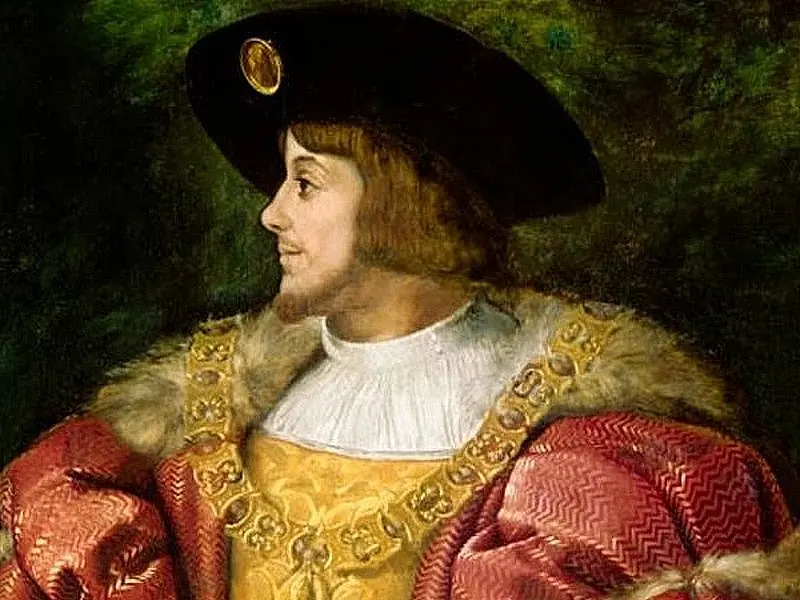
What happens when a sickly ten-year-old boy inherits a kingdom on the brink of collapse? Louis II of Hungary faced this impossible reality in 1516, becoming the last Jagiellon king of a realm already bleeding from within and threatened by the greatest military power of the age. His reign lasted just ten years, ending not in glory but in the muddy waters of the Danube, surrounded by the corpses of his nobility. Yet his death changed the map of Europe forever, handing Hungary to the Ottomans and Bohemia to the Habsburgs—a partition that would last nearly two centuries.
Who Was Louis II? A Child of Dynastic Politics
Born in 1506 to Vladislaus II Jagiellon and Anne of Foix, Louis entered the world as a pawn in Europe’s great power game. His father, desperate for Habsburg protection against the Ottoman threat, betrothed his children before they could walk. In 1515, nine-year-old Louis “married” eleven-year-old Maria of Austria in Vienna’s St. Stephen’s Cathedral—a preliminary wedding, of course, but one that sealed Hungary’s fate. His older sister Anna, barely twelve, wed Ferdinand of Habsburg the same day.
Historians still debate Vladislaus’s wisdom. Yes, he secured imperial backing. But at what cost? The Hungarian nobility seethed at German-Austrian encroachment. They wanted a Hungarian king for Hungarians, not a foreign prince. Vladislaus, however, prioritized family survival over national independence—a decision that would prove fatal.
Young Louis was, by all accounts, a fragile child. Weak, sickly, perhaps suffering from the genetic burdens that plagued the Jagiellon line. When his father died in 1516, the boy was just ten years old. His uncle, Sigismund I of Poland, became his guardian. Hungary was effectively rudderless.

The Peasants’ War: Hungary Eats Its Own
Before Louis could even rule, his kingdom tore itself apart. In 1514, a charismatic minor noble named György Dózsa raised a “crusade” against the Ottomans who had been raiding Hungary since 1512. Over 40,000 peasants, students, monks, and urban poor flocked to his banner—the kuruci, or cross-bearers.
Then came the betrayal. The Hungarian nobility, terrified by this army of commoners, convinced Vladislaus to cancel the crusade. The kuruci, feeling betrayed, turned on their lords. What began as holy war became social revolution.
For months, Dózsa’s forces rampaged through the countryside, capturing cities and executing nobles. The response was savage. In July 1514, 25,000 feudal knights crushed the peasant army. Dózsa was executed in a manner too gruesome to describe—suffice to say it involved a heated iron throne. By year’s end, nearly 50,000 peasants lay dead.
The consequences haunted Louis II’s entire reign. The peasantry was crushed, serfdom intensified, and Hungary’s military strength bled away. When the Ottomans finally came in force, there would be no popular resistance—only the nobles, and they would fail.

Read More:
A King of Three Crowns, Master of None
Louis II’s coronation finally came in January 1522. Sixteen years old, he was declared of age in Székesfehérvár, the traditional coronation city of Hungarian kings. He now wore three crowns: Hungary, Croatia, and Bohemia. Yet he mastered none.
In Bohemia, chaos reigned. Two powerful nobles—Zdeněk Lev of Rožmitál and William II of Pernštejn—nearly sparked civil war in 1520, seizing royal castles and lands. When Louis finally visited in 1522, he dismissed Zdeněk and appointed Prince Karel of Münsterberg. But once the king left, the factional fighting resumed. Bohemia, like Hungary, was ungovernable.
Louis spent most of his brief reign in Hungary, yet even there his authority was nominal. The great magnates did as they pleased. The treasury was empty. The army was feudal, unreliable, and technologically backward. And to the south, Suleiman the Magnificent was preparing something terrible.

The Battle of Mohács: An Hour and a Half of Horror
Summer 1526. Sultan Suleiman I led perhaps 50,000 troops—janissaries, sipahis, and artillery—into Hungary. His goal: conquest, plunder, and the destruction of the Hungarian state. By late August, he had reached Mohács on the Danube’s right bank.
Louis II assembled what he could: 25,000 men, including Czech, Slovak, Croatian, Austrian, Italian, and Polish mercenaries, plus 80 cannons. He expected reinforcements from János Zápolya, Prince of Transylvania, who promised 20,000 troops. Zápolya never came. Historians still debate why—cowardice, calculation, or simply impossibility?
The battle began on August 29, 1526. The Hungarian plan was straightforward: heavy cavalry charge, break the Ottoman line, win the day. It had worked before, against other enemies. It would not work against Suleiman.

The Turks feigned retreat, drawing the Hungarian horsemen into a kill zone. Then their artillery—outnumbering the Hungarian guns more than two-to-one—opened fire. The flower of Hungarian nobility died in minutes. The infantry, abandoned by fleeing cavalry, was massacred from the flanks. Within ninety minutes, it was over.
Fifteen thousand Christians lay dead. The Ottoman casualties were minimal. The Hungarian command was annihilated—bishops, barons, and palatines died alongside common soldiers. Suleiman executed the prisoners and marched on Buda, which fell two weeks later.
Read More:
The Death of a King: Drowning in the Danube
Louis II himself fled the battlefield, surrounded by a small bodyguard. Reaching the Danube, he attempted to swim across. The weight of his royal armor pulled him under. He drowned, just twenty years old, his body lost in the river’s currents.
Two months later, fishermen recovered a corpse in royal armor. It was him—the last Jagiellon king of Hungary, the boy who had never really had a chance. His remains were buried in the Garden of the Ruins at Székesfehérvár, among the tombs of Hungary’s medieval kings.
Or were they? Some historians suggest the body might have been a substitute, that Louis survived and lived in hiding. It’s a comforting thought, but unlikely. The armor, the location, the timing—all point to a sad truth: the king died as he had lived, overwhelmed by forces beyond his control.

Aftermath: The Partition of Hungary
Louis II’s death triggered catastrophe. The Habsburg succession, negotiated by his father decades earlier, came into effect. His sister Anna’s husband, Ferdinand, claimed Hungary and Bohemia. But the Ottoman conquest was incomplete—central Hungary became a Turkish province, while Transylvania became a vassal state. The kingdom was split three ways.
This “tripartite Hungary” lasted until 1699. For nearly 170 years, the heart of the kingdom was Ottoman territory. The Habsburgs ruled only the western and northern peripheries. The dream of a unified, independent Hungary died at Mohács, drowned with its young king.
Was it Louis’s fault? Historians argue still. He was young, inexperienced, saddled with a bankrupt treasury and feudal anarchy. Yet he made crucial errors: trusting Zápolya, choosing the wrong battlefield, failing to wait for reinforcements. Perhaps a more seasoned king could have done better. Perhaps not.

Read More:
Memory and Myth: The Last Hungarian King
Louis II’s legacy is complicated. In Hungary, he is remembered as a tragic figure—the last native king before foreign domination. A statue stands at Mohács, showing him in armor, eternally young. The battle itself became a national trauma, “Mohács” entering the language as shorthand for disaster.
Yet popular culture has been less kind. The Turkish television series Magnificent Century (2011-2014) portrayed Louis as hot-tempered and unstable, played by a forty-year-old actor despite the king’s youth. This aging perhaps serves Turkish nationalism—making Suleiman’s victory seem more significant by defeating a mature opponent rather than a desperate boy.
The truth is simpler and sadder. Louis II was a child of dynastic politics who inherited an impossible situation. He tried, failed, and died. His wedding at nine, his coronation at sixteen, his death at twenty—his whole life was a lesson in how medieval power politics crushed individuals, even kings.
Could anyone have saved Hungary in 1526? Or was Louis II doomed from birth, a sacrifice to his father’s Habsburg alliance and his kingdom’s internal rot? History offers no comfort, only the echo of cannons at Mohács and the splash of a young king sinking beneath the Danube’s waters.