
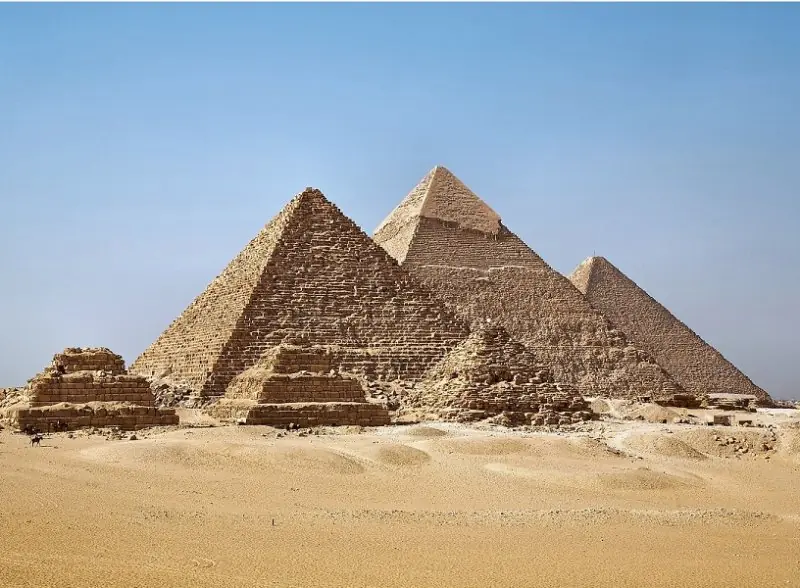
What country can claim to be both the cradle of human civilization and a modern geopolitical powerhouse? Egypt stands alone in this distinction. For over five millennia, this ribbon of fertile land along the Nile has witnessed the rise and fall of empires, the birth of writing and monumental architecture, and transformations that would have seemed unimaginable to the pyramid builders. Today, more than 106 million people call Egypt home, living in the shadow of monuments that have endured since before the Trojan War. Yet Egypt is not merely a museum piece—it’s a dynamic Arab republic that controls one of the world’s most crucial maritime chokepoints and mediates conflicts across the Middle East.
Ancient Egypt: Where Civilization Began
Imagine a world without history books, without written records of any kind. Then picture the moment when symbols on clay tablets began capturing human thought for posterity. That revolution happened here, in the Nile Delta, around 3200 BC. When Pharaoh Narmer united Upper and Lower Egypt around 3150 BC, he created something unprecedented: a centralized state with defined borders, professional administration, and divine kingship.
The pharaohs who followed built wonders that still defy comprehension. Djoser’s step pyramid at Saqqara, rising six stepped tiers toward heaven, established the template for Egyptian funerary architecture. Senusret I’s obelisk at Heliopolis—still standing after nearly 4,000 years—demonstrated the Egyptians’ mastery of granite quarrying and single-piece stone carving. And then there was Hatshepsut, the woman who ruled as king, wearing the false beard and regalia of male pharaohs while commissioning trading expeditions to the mysterious land of Punt.

But perhaps no pharaoh captures the imagination like Ramesses II, “the Great.” Ruling in the 13th century BC, he fought the Hittites at Kadesh, built Abu Simbel’s colossal rock temples, and erected more monuments than any other Egyptian ruler. His mummy, with its aquiline nose and flowing white hair, still rests in Cairo’s Egyptian Museum—a human connection across thirty-two centuries.
The last of the pharaohs, Cleopatra VII, belonged to a different world entirely. A Greek-speaking Ptolemy ruling a multicultural kingdom, she allied with Julius Caesar and Mark Antony before falling to Octavian’s forces in 30 BC. Her suicide—whether by asp bite or poison remains debated—ended not just a dynasty but 3,000 years of pharaonic rule. Egypt became Rome’s breadbasket, its priests gradually fading from power as Christianity spread after Constantine’s conversion in 313 AD.

Read More:
From Byzantine Cross to Islamic Crescent: Egypt’s Medieval Transformation
The Egypt of the Roman emperors looked radically different from the land of the pharaohs, yet strange continuities persisted. Roman emperors were depicted in pharaonic regalia, given five royal names in the ancient tradition. The Egyptian priesthood, guardians of esoteric knowledge for three millennia, finally dissolved in the third century AD—victims of Christianity’s triumph.
Byzantine rule (395-645 AD) brought Greek Orthodox Christianity and new administrative structures, but the Nile continued its eternal rhythm. Then came the earthquake: Arab armies conquered Egypt in 645, bringing Islam and the Arabic language. Within centuries, Egypt became the intellectual and cultural heart of the Islamic world. Al-Azhar University, founded in 972 AD in the newly established capital of Cairo, remains one of Islam’s most prestigious centers of learning.
Ottoman control followed in 1517, reducing Egypt to a province ruled by Turkish pashas. Yet Ottoman weakness allowed local Mamluk beys to wield real power, creating a semi-autonomous state that traded with Europe and built the coffee houses and mosques that still define Cairo’s medieval quarter. This period of “Ottoman Egypt” lasted until Napoleon Bonaparte’s invasion in 1798—a brief French interlude that shattered old structures without establishing new ones.

Modern Egypt: Suez, Empire, and Independence
The nineteenth century transformed Egypt more radically than any period since the Arab conquest. Muhammad Ali Pasha, an Albanian Ottoman officer who seized power in 1805, dreamed of building a modern industrial state. He constructed factories, irrigation works, and a professional army that briefly threatened the Ottoman Sultan himself. His successors expanded cotton cultivation, built railways, and—most fatefully—constructed the Suez Canal.
The canal changed everything. When Ferdinand de Lesseps’s waterway opened in 1869 after eleven years of brutal construction, it slashed 8,000 kilometers off the journey from Europe to Asia. Port Said and Suez became global hubs; Ismailia rose from desert sand as a planned European city. Yet the cost was staggering—financially and humanly. Egypt’s debt to European creditors mounted until, in 1882, British forces occupied the country to protect their investments.
Formal British protectorate status came in 1914, lasting until 1922. Then followed a constitutional monarchy under King Fuad and his son Farouk—a period of nationalist agitation, cultural renaissance, and growing anti-colonial sentiment. The 1952 revolution, led by the Free Officers Movement, ended the monarchy entirely. Gamal Abdel Nasser emerged as the charismatic leader of a republic that would dominate Arab politics for decades.
Nasser’s legacy is complicated. He built the Aswan High Dam, controlling the Nile’s floods and generating electricity, but also entangled Egypt in disastrous wars with Israel. The 1979 peace treaty with Israel, signed by his successor Anwar Sadat, cost Sadat his life to assassins’ bullets but secured Egypt’s Western alignment and American aid. Today, Egypt remains that rare Middle Eastern state: at peace with Israel while maintaining credibility with Palestinian factions.

Read More:
The Suez Canal: Egypt’s Geographic Jackpot
Modern Egypt’s economy revolves around a simple fact of geography. The Suez Canal, that 160-kilometer slash through the Isthmus of Suez, handles roughly 12% of global trade. In 2024 alone, transit fees generated $9.4 billion for the Egyptian treasury—money that helps feed a population growing by millions annually.
The canal’s importance cannot be overstated. Without it, container ships traveling from Shanghai to Rotterdam would face an additional two weeks sailing around Africa’s Cape of Good Hope. When the Ever Given blocked the canal for six days in 2021, global trade shuddered; losses ran into billions. Egypt’s control of this chokepoint gives it leverage disproportionate to its economic size.
Yet geography is a mixed blessing. The canal also makes Egypt vulnerable. Israeli forces crossed it in 1973; terrorists have targeted it repeatedly. The Sinai Peninsula, returned to Egypt in 1982, remains a security challenge where ISIS-affiliated militants clash with Egyptian troops. Balancing openness to global commerce with internal security is a constant tightrope walk.

Modern Egyptian Society: Tradition and Transformation
Walk through Cairo today and you’ll encounter layers of history stacked like geological strata. Medieval mosques rub shoulders with Belle Époque apartment blocks and brutalist government towers. Over 20 million people crowd the Greater Cairo area, making it Africa’s largest city and one of the world’s most densely populated urban zones.
Egypt’s demographic realities are stark. More than a third of the population works in agriculture, mostly along the Nile Valley and Delta where ancient irrigation systems still function. Another half works in services—tourism, government, commerce—while industry employs about 17%. The Great Pyramid of Giza, the only surviving Wonder of the Ancient World, draws millions of visitors annually, as do Luxor’s temples and the Red Sea resorts of Sharm el-Sheikh and Hurghada.

Religious identity remains central. Approximately 85% of Egyptians are Sunni Muslims; the Coptic Christian minority, perhaps 15%, traces direct descent from ancient Egyptians and maintains traditions dating to the first century AD. The Coptic language, descended from ancient Egyptian and written in the Greek alphabet, survives in liturgical use—a living connection to the pharaohs.
Culturally, Egypt dominates the Arab world. Cairo’s film industry produces movies watched from Morocco to Iraq; Egyptian Arabic is the most widely understood dialect. Yet this cultural soft power contrasts with economic struggles. Despite Suez revenues and tourism, Egypt faces chronic unemployment, inflation, and the challenge of educating a youth bulge where the median age is just 24.
Read More:
Egyptology: The Science of Wonder
Modern Egypt’s relationship with its ancient past is complex. The science of Egyptology—born when Jean-François Champollion deciphered hieroglyphics in 1822—was largely a European enterprise. Foreign archaeologists extracted treasures for Western museums, often with scant regard for Egyptian ownership. The busts of 23 great Egyptologists displayed in Cairo’s Egyptian Museum include only a handful of Egyptians or Arabs.
Yet this is changing. Egyptian archaeologists now lead major excavations; the Grand Egyptian Museum, scheduled to fully open near Giza, will be the world’s largest archaeological museum. Zahi Hawass, Egypt’s former antiquities minister, became a global celebrity while insisting on the repatriation of stolen artifacts. The Rosetta Stone remains in the British Museum, but its Egyptian future seems increasingly possible.

Popular culture keeps ancient Egypt alive. Elizabeth Taylor’s Cleopatra (1963) remains iconic, while The Mummy franchise (1999-2017) introduced new generations to pyramids and curses. Verdi’s opera Aida, commissioned to celebrate the Suez Canal’s opening, still fills opera houses with its spectacle of pharaonic Egypt. These romanticized visions may distort history, but they ensure Egypt’s ancient civilization remains part of global imagination.
Conclusion: The Eternal River
Egypt’s story is ultimately one of adaptation. The pharaohs gave way to Romans, Byzantines, Arabs, and Ottomans; each layer added to the cultural palimpsest. British occupation yielded to nationalism, monarchy to republic, socialism to economic liberalization. Through it all, the Nile flows—sometimes generous, sometimes devastating, always essential.
The challenges facing modern Egypt are immense: water scarcity as Ethiopia builds dams upstream, population growth straining resources, the need to create jobs for millions of young people. Yet if 5,000 years of history teach anything, it’s that Egypt endures. The same ingenuity that raised pyramids and carved canals will, perhaps, find solutions to 21st-century crises.

Read More:
Can any modern nation claim such continuity with its ancient past? Egypt’s ability to remain simultaneously ancient and contemporary, traditional and modern, local and global, makes it unique. The pharaohs would recognize the Nile’s centrality; they might be baffled by smartphones and skyscrapers. But they would understand the fundamental truth: Egypt is not just a place—it’s an idea that has persisted through every transformation history could devise.