
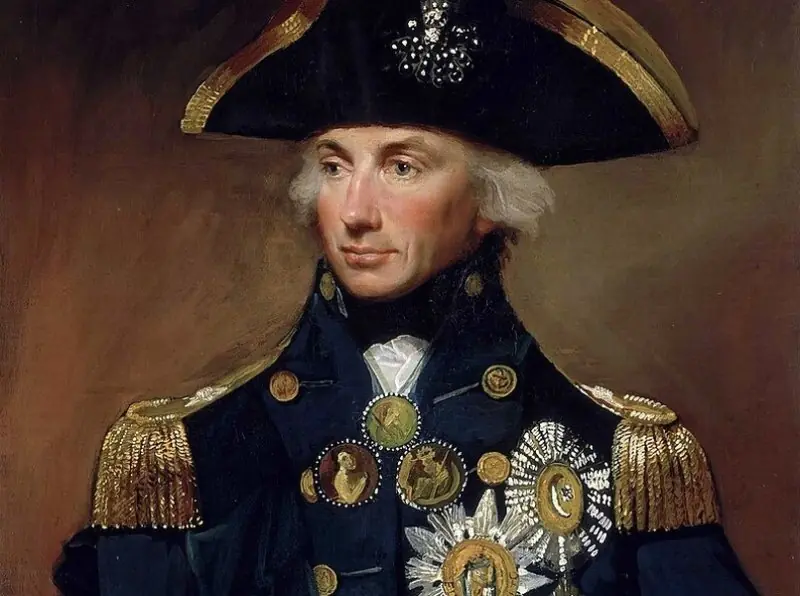
What does it take to become a national hero when you’re physically broken before your greatest victories? Horatio Nelson was short, sickly, prone to seasickness, and eventually lost an eye and an arm—yet he secured British naval dominance for a century and died at the moment of his greatest triumph. His statue towers 52 meters above London’s Trafalgar Square, his preserved flagship HMS Victory draws millions in Portsmouth, and his name still echoes through British military history. But the real Nelson was more complicated than the marble icon: a man of astonishing courage and shocking scandal, tactical genius and personal chaos, who transformed naval warfare while breaking every social convention of his age.
The Unlikely Sailor: How a Sickly Boy Became Captain at Twenty
Imagine a thirteen-year-old boy, barely five feet tall, constantly nauseated by ocean swells, insisting on a naval career against all logic. That was Horatio Nelson in 1771, joining his uncle’s ship as a midshipman. His father, an Anglican parson with eleven children, must have wondered at his son’s determination. His uncle, Captain Maurice Suckling, certainly did. Yet Nelson possessed something that overcame his physical limitations: absolute, reckless courage.
The Arctic expedition of 1773 provided early proof. According to legend—possibly apocryphal, certainly revealing—fifteen-year-old Nelson spotted a polar bear on an ice floe during night watch. Grabbing a musket, he pursued the animal across the ice. When his weapon misfired, he attacked the bear with the gun butt, intending hand-to-hand combat. Only a warning shot from the ship’s captain prevented the teenager from becoming a carnivore’s dinner. Whether true or not, the story captures Nelson’s essential character: he simply did not recognize fear.

By 1778, at age twenty, Nelson commanded the 28-gun frigate HMS Hinchinbrook. This was not nepotism—his uncle had died years before. Nelson earned his promotion through relentless competence: mastering navigation, studying gunnery, demonstrating leadership in the West Indies and Central America. During operations against Spanish forts in 1780, he contracted malaria, nearly died, and returned to England a seasoned commander at twenty-two.
Yet the peacetime navy offered little opportunity. For five years, Nelson performed routine duties: patrolling, enforcing trade laws, escorting convoys. In 1787, he married Frances Nisbet, a young widow from Nevis, and seemed destined for a quiet career in an increasingly quiet service. Then the French Revolution exploded, and everything changed.
Read More:
The Making of a Legend: Corsica, the Nile, and Emma Hamilton
War with Revolutionary France in 1793 thrust Nelson back into action as captain of HMS Agamemnon. The Mediterranean became his theater, and he quickly demonstrated the aggressive tactics that would define his career. During the siege of Calvi in 1794, a French cannonball struck the wall beside him. A stone fragment destroyed his right eye. The eyeball remained intact—Nelson never wore the famous eyepatch later artists gave him—but his vision was gone.
Did this slow him down? Hardly. In 1795, commanding the outgunned Agamemnon against two French ships of the line, he captured both. The following year brought his most audacious exploit yet: the “Nelson Touch” at Cape St. Vincent. When his ship Captain broke formation and charged the Spanish fleet alone, Nelson didn’t retreat—he boarded. First the San Nicolas, then the San José, both captured in bloody hand-to-hand fighting while the ships were entangled. Four enemy vessels taken, two by Nelson personally. He was knighted and promoted to rear admiral.

Then came disaster. In 1797, attacking Santa Cruz de Tenerife, grapeshot shattered his right arm above the elbow. The surgeon’s knife removed it at the shoulder. Nelson felt the phantom pain of the missing limb for the rest of his life—a constant reminder of the costs of his profession.
Yet 1798 brought his greatest triumph. Napoleon had landed in Egypt; Nelson hunted his fleet across the Mediterranean for months. Finally, at the Battle of the Nile (Aboukir Bay), he destroyed the French fleet in a night action of devastating effectiveness. Thirteen of seventeen French ships captured or destroyed; Napoleon’s army stranded in Egypt. Nelson was wounded in the forehead—another scar, another near-miss—but emerged a baron and the Mediterranean’s master.
It was in Naples, celebrating this victory, that Nelson met Emma Hamilton. The wife of the elderly British ambassador, twenty years Nelson’s junior, beautiful, charismatic, and already famous across Europe, Emma became his mistress. Their affair would last until his death, produce a daughter named Horatia, and scandalize British society. Nelson abandoned his wife; Emma eventually abandoned her husband. When Emma died in poverty in 1815, the nation that worshipped Nelson had forgotten her entirely.

Trafalgar: The Battle That Made History
By 1803, Nelson commanded the Mediterranean Fleet again, blockading the combined French and Spanish navies in Cádiz. For two years, he maintained the close blockade—grueling, tedious, essential work. Then, in October 1805, the combined fleet emerged. Nelson had his chance.
His battle plan was revolutionary. Conventional naval tactics emphasized parallel lines of battle, exchanging broadsides until someone broke. Nelson divided his fleet into two columns and drove them straight at the enemy’s line, perpendicular to their guns. The leading ships would endure devastating fire during approach; once through, they would break the enemy formation and create chaos. It was brilliant, risky, and perfectly suited to British gunnery superiority and Nelson’s faith in his captains’ initiative.
“England expects that every man will do his duty,” Nelson signaled as the fleets closed. The famous flag message—originally “England confides,” changed to “expects” for easier signaling—encapsulated his leadership style: clear objectives, trust in subordinates, shared purpose.

The Battle of Trafalgar began around noon on October 21, 1805. Nelson, aboard HMS Victory, led one column directly at the French flagship Bucentaure. The approach was murderous; Victory’s sails were shredded, her hull pounded by shot. But she broke through, and the British advantage in gunnery told. One by one, the French and Spanish ships surrendered.
Then, around 1:15 PM, a French sharpshooter in the rigging of the Redoutable spotted Nelson on Victory’s quarterdeck. The bullet struck the admiral in the left shoulder, passed through his spine, and lodged in his right shoulder blade. He fell, covered in blood, and was carried below.
Read More:
The Death of a Hero: Rum, Grief, and Immortality
Nelson knew he was dying. “They have done for me at last, Hardy,” he told his flag captain. His concerns were characteristic: the fleet’s safety, the fate of his captains, Emma Hamilton’s provision. “Take care of my dear Lady Hamilton,” he begged. “Take care of poor Lady Hamilton.” He reminded Hardy to anchor, to prevent a dangerous night pursuit. He expressed satisfaction that he had done his duty.

Three hours later, as Victory’s guns fell silent in victory, Nelson died. The fleet had captured or destroyed nineteen enemy ships without losing a single British vessel. Napoleon’s naval threat was eliminated; British supremacy assured for a century. But the price was the nation’s greatest sailor.
Preserving Nelson’s body for burial in England posed immediate problems. The solution was macabre but practical: he was placed in a cask of brandy—rum in some accounts—mixed with camphor and myrrh, and lashed to Victory’s mainmast. For six weeks, as the ship sailed home, the cask was guarded around the clock. The spirit that preserved him also, reportedly, was tapped by thirsty sailors—a grim detail that adds human texture to the legend.
Nelson’s funeral on January 9, 1806, was unprecedented. His body lay in state at Greenwich Hospital, then was transported up the Thames in a funeral barge. At Whitehall, his coffin—made from the timbers of L’Orient, the French flagship destroyed at the Nile—was placed on a funeral car drawn by six black horses. The procession to St. Paul’s Cathedral included thirty-two admirals, over a hundred captains, and representatives of every European nation. He was buried in the cathedral’s crypt, the first non-royal to receive such an honor.

The Nelson Legacy: Hero, Scoundrel, Icon
How should we remember Horatio Nelson? The official narrative emphasizes Trafalgar, duty, and sacrifice. Nelson’s Column, erected between 1840 and 1843, towers 46 meters in Trafalgar Square—London’s geographic and symbolic center. The 5.5-meter statue atop faces Portsmouth, where HMS Victory remains preserved, the world’s oldest commissioned warship. Monuments dot Britain from Edinburgh to Barbados. His image appeared on stamps across Europe; coins commemorate his victories from the Isle of Man to the Falkland Islands.
Yet the full picture includes Emma Hamilton, the abandoned wife, the illegitimate daughter. It includes his vanity—Nelson was obsessed with his reputation—and his occasional pettiness. It includes his tactical gambles that might easily have failed, and the thousands who died executing his plans. Nelson was no saint; he was a man of his age, with that age’s virtues and vices magnified by extraordinary circumstances.

What remains undeniable is his impact. Before Nelson, naval battles were often indecisive, admirals cautious, command centralized. Nelson trusted his captains—his “band of brothers”—to act independently, to seize initiative, to engage closely. His column tactics at Trafalgar revolutionized naval warfare. His personal example—leading from the front, sharing dangers with common seamen—created the template for British naval leadership.
Cinema has loved and simplified him. Lady Hamilton (1941), starring Laurence Olivier and Vivien Leigh, won Oscars while distorting history into romance. More than two dozen films have attempted his story; none quite capture the contradictions of the man who was simultaneously the navy’s most disciplined commander and its most scandalous officer.

Read More:
Was Nelson Britain’s greatest military leader? The case is strong: no other single victory had Trafalgar’s strategic impact; no other commander so completely dominated his era. Yet his true legacy may be simpler: the proof that physical disability, social convention, even common sense, need not limit human achievement. Short, one-eyed, one-armed, and frequently seasick, Horatio Nelson conquered the world’s oceans and died at the moment of supreme victory. “Thank God I have done my duty,” he said. Indeed he had—and changed history in the doing.